Alloggiati Web: duties, deadlines and penalties for hosts
Updated 14.09.2026
Every person who sleeps in your house must be reported to the Questura within 24 hours of arrival. It applies to the whole house and to a single room, to the paying guest and to a family friend, to a booking from Booking.com and to one taken over the phone. This is not a tax rule but a public security rule, which is why it looks at the person sleeping under your roof, not at the contract.
- Who must report guests
- Questura credentials: how to get them
- How long you have
- The guest form and the guest type codes
- The receipt: thirty days to take it, five years to keep it
- If the portal is down
- Checking the guest's identity and key boxes
- Penalties
- How Chilloso solves it
- Frequently asked questions
Who must report guests to the Questura
The duty comes from article 109 of the TULPS and applies to the operators of hotels and of every other kind of accommodation. That wording also covers holiday homes and short-term tourist lets, meaning stays under thirty days.
It makes no difference whether you host as a business or as a private individual. It makes no difference which platform the booking came from: neither Airbnb nor Booking pass guest data to the Italian State Police on your behalf. And it makes no difference whether the guest pays — the rule applies to anyone who provides accommodation on any basis, including free of charge.
Questura credentials: how to get them
Before you can report anything you need credentials for the portal. You apply once, to the Questura of the province where the property is located — not the one where you live.
- Download the credentials request form from the website of the competent Questura; every province has its own.
- Attach a copy of the identity document of whoever runs the property.
- Attach the document that authorises the activity — SCIA, licence or the tourist letting notice filed with the municipality — together with the property's identification code.
- Send everything as a single PDF to the certified email address indicated by the Questura.
The credentials come back the same way. They are personal and non-transferable, and along with them you receive a digital certificate used to sign each transmission. Keep username, password and certificate safe: if the certificate is lost, the Questura has to issue a new one.
How long you have
Within 24 hours of arrival. If the stay is shorter than a day, the time drops to six hours. The clock starts at the guest's arrival, not at booking and not at check-out.
The guest form and the guest type codes
For each person the portal asks for the same set of details: surname, first name, sex, date and place of birth, citizenship, type and number of the document, place of issue, arrival date and expected length of stay. If four people sleep in the house, that is forty pieces of data.
The part that confuses almost everyone is classifying the guest. The portal wants a code for each one:
| Code | Guest type | When it applies |
|---|---|---|
| 16 | Single guest | a person travelling alone |
| 17 | Head of family | the reference adult of a family unit |
| 18 | Group leader | the reference person of a group of friends or colleagues |
| 19 | Family member | the other members of the family, children included |
| 20 | Group member | the other members of the group |
Minors are reported like everyone else: they are entered as family members and linked to the head of family. If a child has no document of their own, the document of the parent with legal responsibility is used instead.
The receipt: thirty days to take it, five years to keep it
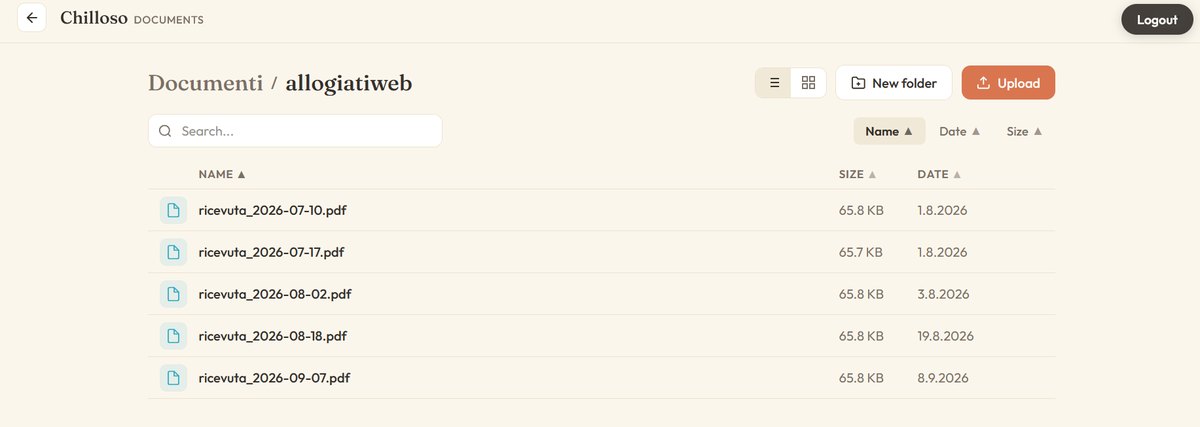
The day after each submission the portal issues a digital receipt with a unique code. That receipt — not the guest form — is what proves you complied, and it must be kept for five years. In digital form: it carries an electronic signature from the service, so a printout does not have the same value.
The point almost everyone misses: on the portal the receipt stays downloadable for thirty days, then it disappears from view. If you have not taken it within those thirty days, an inspection will find you with nothing in hand — and a guest form with no surviving proof weighs, in a check, the same as one never sent.
It is worth keeping two copies in two different places. A failed disk, a replaced phone or a new computer can cost you five years of evidence.
If the portal is down
A technical failure does not suspend the duty, but there is a procedure for it: the alternative reporting form, to be filled in and sent at once to the competent Questura by certified email. The form is on the Questura's website. It covers the time strictly needed to fix the problem, and it is meant to be used, not ignored: reporting late without having followed this route leaves you in the same position as not reporting at all.
Checking the guest's identity and key boxes
Since November 2025 a second duty sits beside the first: before handing over the house you must verify that the document really belongs to that person. In person, or by video call at the moment of arrival.
A key box with a code is no longer enough on its own. You may keep using one, but entry must be preceded by a real-time identity check: collecting documents in advance does not replace that step.
Penalties
If the report is not filed, or is filed late, this is not an administrative fine: it is a criminal offence. Up to three months' detention or a fine of up to 206 euros.
That is the difference almost nobody expects. An administrative fine is paid and the matter ends there; a criminal contravention is something else, and it stays on record.
How Chilloso solves it
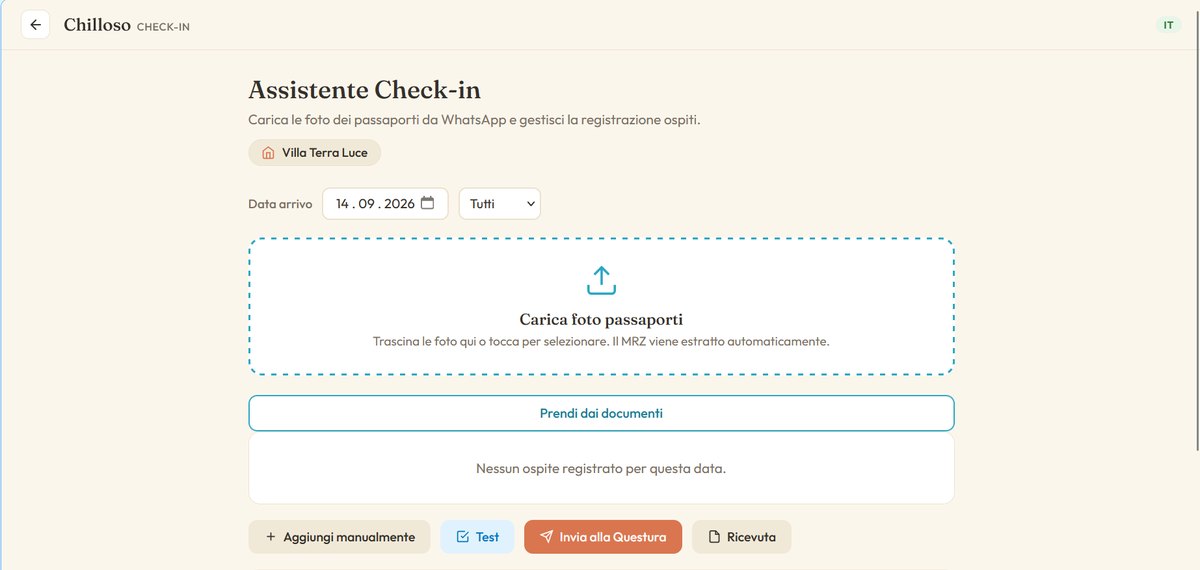
Guest data is entered once, at booking. Chilloso files it with the portal on time, collects the receipt as soon as it appears, and puts it in your archive, where it stays for the required five years. Every receipt is stored on two servers in different places: if one goes down, your archive stays whole.
You never open the portal, never remember a deadline, never hunt for a receipt from two years ago: it is where you left it.
Do you need more information?