CIN for a holiday rental in Italy: how to get it, where to display it, what it costs to get wrong
Updated 14.09.2026
The CIN is the number that identifies your house in the national tourism database. Applying for it costs nothing, but without it you do not exist: alongside the fine, the law provides for the immediate removal of the irregular listing. It is not a penalty that might turn up one day — it is the house no longer being bookable.
Three things, not one
The stumble is almost always the same: apply for the code, put it in the listing, stop there. Article 13-ter of D.L. 145/2023 sets out three obligations, and they go together.
- Apply for the CIN from the Ministry of Tourism, which assigns it through the national database of accommodation providers.
- State it in every listing, wherever published: portals, social media, your own site.
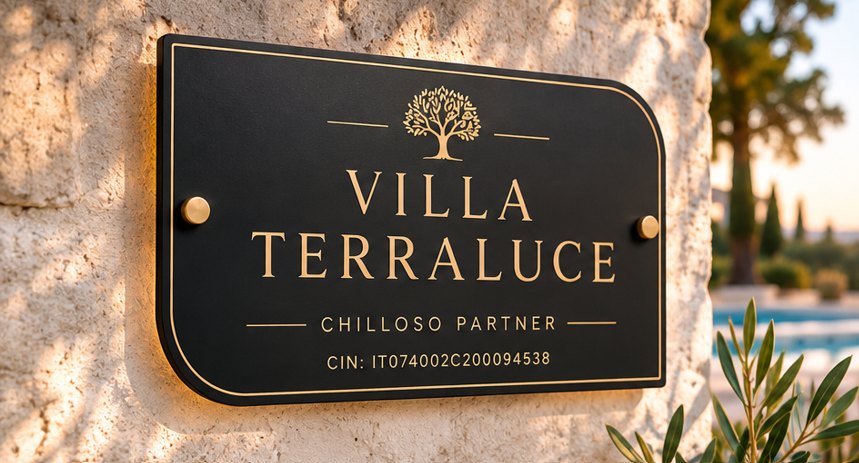
- Display it outside the building in which the apartment or the property is located.
The CIN applies to houses let for tourism purposes, to short lets under art. 4 of D.L. 50/2017 and to hotel and non-hotel accommodation providers. Whether you let all year or for two weeks in August makes no difference.
How to get the CIN
The application is online and free: a request to the Ministry of Tourism with a substitute declaration under arts. 46 and 47 of D.P.R. 445/2000, attesting the cadastral details of the property and, for landlords, the safety requirements. You need a digital identity; if a property manager handles it, a power of attorney is required.
In Puglia there is a step before that: registration in the regional DMS, which produces the property code. It is a prerequisite — without it there is no CIN.
Anyone who already held the regional code did not have to start over: paragraph 2 of article 13-ter obliges the regional authority to recode existing codes automatically as CIN, adding an alphanumeric prefix supplied by the Ministry. In Puglia your CIN contains your old code.
The safety you declare when you sign
Paragraph 7 draws two distinct levels, and it is worth reading closely: almost everyone reports it wrongly.
The safety requirements for installations under state and regional law apply to units run in business form. But the second part of the paragraph says “in any case, all residential units”: working detectors for combustible gas and carbon monoxide, and portable fire extinguishers to standard, in accessible and visible positions, near the entrances and the areas of greatest risk, one per 200 square metres of floor area or part thereof, with a minimum of one per storey. For the type of extinguisher the law refers to point 4.4 of annex I to the Interior Ministry decree of 3 September 2021.
This is not a box to tick: you self-certify these requirements in the very application through which you obtain the CIN, under D.P.R. 445/2000. The flat detector in a drawer and the expired extinguisher in the cellar are not an administrative oversight; they are a declaration you signed that does not match reality.
Displaying the CIN outside
Paragraph 6 requires the CIN to be displayed outside the building in which the apartment or property is located. Not indoors, not in the welcome folder.
In the same sentence the law adds a clause that carries weight here: “ensuring compliance with any town-planning and landscape constraints”. On a dry-stone wall in the old town, or on a listed trullo, how you do it matters as much as whether you do it. A plain plaque, mounted without cutting into the stone, settles both.
The CIN in every listing, your own site included
“In every listing wherever published and communicated”: the wording is deliberately broad. Booking, Airbnb, the Facebook page, the flyer — and above all your own site, where almost nobody remembers it. On the portals the code is there because they put it there; on a home-made site almost never.
The same paragraph also binds estate agents and operators of booking portals: they too must state the CIN in the listings they publish. And among the penalties in paragraph 9, alongside the fine, is the immediate removal of the irregular listing.
What getting it wrong costs
The penalties in article 13-ter, paragraph 9, are separate and they add up: an inspection that finds three failings produces three notices.
| What is missing | Penalty | How it is counted |
|---|---|---|
| The CIN | €800 to €8,000 | in relation to the size of the property |
| Display or statement of the CIN | €500 to €5,000 | per property or unit, plus immediate removal of the listing |
| Detectors or extinguishers | €600 to €6,000 | for each violation found |
| The SCIA, if you let in business form | €2,000 to €10,000 | in relation to the size of the property |
Checks and penalties fall to the municipality where the house is located, through the local police, under law 689/1981; the proceeds stay with the municipality and are earmarked for tourism investment and for waste collection and disposal. On the tax side, paragraph 12 tasks the Revenue Agency and the Guardia di Finanza with risk analyses aimed precisely at identifying those letting without a CIN.
One valve almost nobody mentions: paragraph 10 provides that the penalties in paragraph 9 do not apply if the same act is already penalised under regional law. It is not a discount on the obligation — it is the bar on being punished twice for the same thing.
The CIN and the regional code in Puglia
A fair amount of confusion circulates here. The code to be displayed and put in listings is the CIN: the Puglia region says so itself in its FAQ, adding that nothing prevents you from displaying the regional code as well. Not two obligations, but one mandatory and one optional.
The regional code does not disappear, though: it remains the necessary step towards the CIN and the reference for obligations towards the region, starting with the monthly transmission of guest movements. Note the name as well: regional law 15/2025 rewrote article 10-ter calling it CIR, while the portal still prints it as CIS, and the regional FAQ use the two abbreviations interchangeably. It is the same code.
How Chilloso solves it
The plaque for outside comes from us: the name of your house and your CIN, on a rigid panel finished in 3M Scotchcal film — the same film used on shop signs and vans, made to live outdoors. Five colours, you choose.
It is designed for the stone wall too: it mounts without building work and without cutting into the façade, so the display obligation is met without running into the constraints. And to the guest arriving, the house introduces itself.
Do you need more information?