Your own website for a holiday rental in Italy
Updated 14.09.2026
Anyone who has seen your house on a portal almost always does one more thing before deciding: they type the name into Google. They look for photos without the portal's filter, for who is behind it, for a price without the commission inside. If they find nothing of yours at that point, they stay where they were — and you pay commission on a guest who had already chosen you.
On a portal you are an advert
A portal is a shop window, and it works: it shows you to people who did not know you existed. But what it shows is not your house: it is a card built like ten thousand others, with a limited number of photos, a trimmed text and a price with the commission inside.
That a portal listing also brings traffic to your own site has long been known in the industry as the billboard effect: people see the advert and then look the property up themselves. How strong the effect is today is debated; the behaviour remains: before paying, people search.
What changes with an address of your own
Whoever books there books with you, with no commission. On a house at 480 euros a night that is nearly eighty euros staying with you every night.
You set the rules: the price you want, the minimum stay you want, the deposit you want, your own cancellation policy. Nobody changes them overnight.
You use all the photos, not the six that fit the portal's format. And you describe the house in your own words: the olive trees, the view, the terrace in the evening.
The guest writes to you before booking, directly, and you have their real address — not a portal alias nobody reads. Whoever has stayed once comes back without going through anyone.
And if tomorrow a portal changes its terms or raises its commission, your house is still there online: the address is yours.
Being found on Google: two different routes
This is where almost everyone takes the wrong turn, and it is worth knowing before losing time.
The Google Business Profile — the one that creates the Maps entry — is meant for businesses with a physical presence: a B&B, an agriturismo, a guest house, a staffed rooms-to-let, or the office of a management company where clients are received. A holiday home with nobody on site does not fall into that category.
For rental homes there is the other route: Google Vacation Rentals, the free comparison Google shows inside its travel results. There is no sign-up form: Google takes the data from connected channels, from property management systems and from direct booking sites. Without a site that can accept a booking, that route is closed.
In one line: your own site is not only for whoever looks you up by name. It is also the condition for appearing where Google compares holiday homes — and that traffic costs no commission.
The CIN belongs in every listing, your site included
One duty many forget precisely on their own site: since 2025 the CIN must appear in every listing and in every advertisement for the property. Portals show it because they are required to; home-made sites almost never do.
What a site that brings bookings must have
- The free dates visible, from the same calendar as the portals. A site showing nights already sold does more harm than good.
- The ability to book or enquire without leaving the site and without writing an email into the void.
- The languages of your guests, written properly.
- Large photos and the house described, not a list of amenities.
- The phone: more than half of searches happen on mobile.
- The CIN, contact details and terms.
The site's languages are not a detail
Almost one arrival in two in Puglia comes from abroad. A site only in Italian cuts out half the market, and a machine-translated site cuts it out more elegantly but no less effectively: someone reading a clumsy description in their own language does not write, they close the page.
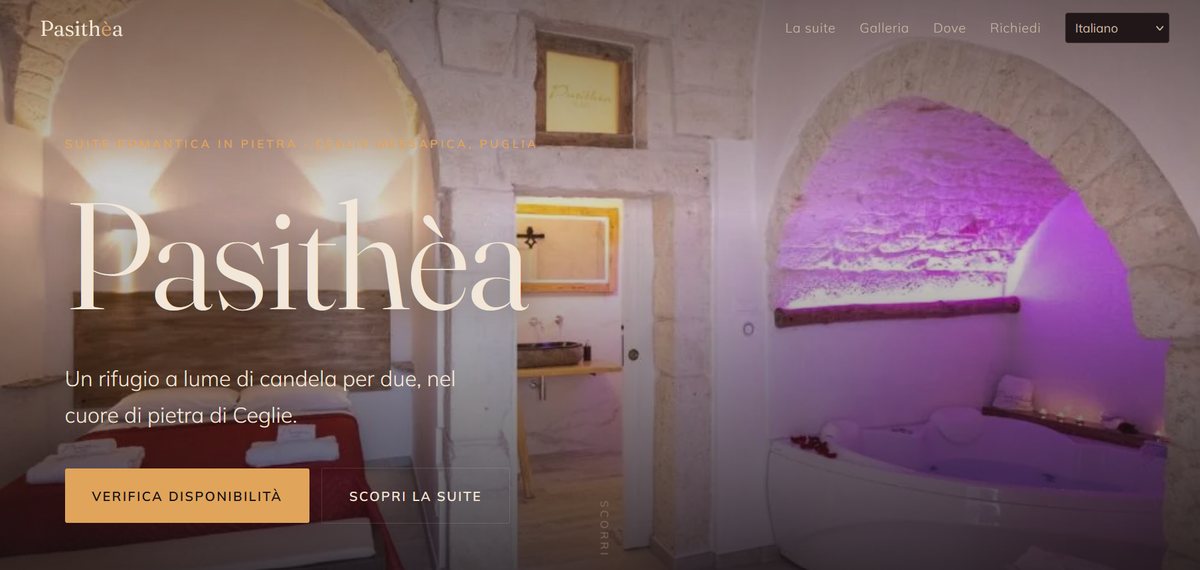
How Chilloso solves it
You do not have to have the site built by anyone and you do not pay for it separately: it is in the price. Every house has its own domain and its own site, with its photos and its texts in nine languages, written by hand and not run through a translator.
And it is not a mute window: the guest sees the dates, asks, books. Enquiries and bookings arrive straight into your Chilloso communication, translated into your language, and the dates stay aligned with those on the portals.
Do you need more information?